Learn the language.
Using "skimo" to mean ski mountaineering flags you as either: a non-English speaker, which is fine; or a beginner, which might not be what you're going for.

Imagine going to a steep skiing film at the Banff Mountain Film Festival. One of the also-ran ski films is playing at a pub, and you're sitting at the back. At the table next to you is a bearded, salt-and-pepper-haired gentleman. His puffy jacket has duct tape covering the holes. And the logo. His face is a mix of a goggle tan and windburn.
"So how long have you been into skimo?" you ask.
If he's nice, maybe he'll smile. If he's not, maybe he'll spit.
The fastest way to be flagged as a beginner is to use "skimo" to describe anything but racing. Long-time backcountry skiers don't use the word unless—like my climber friends—they do it sarcastically.1
When planning the weekend, experienced backcountry skiers ask, "Skiing Saturday?" The type of skiing is implied. Or if they also frequent ski hills, a distinction may be made with, "Touring on Saturday?" Or via the objective: "What about the 3-4 on Sunday?"
Think of "skimo" as short-hand. "Ski mountaineering racing" has always been too much of a mouthful. So it became "skimo racing", and amongst racers—whether or not they backcountry ski—it's "skimo".
- "ski mountaineering racing" -> "skimo racing" -> "skimo"
"skimo" means racing.
What's the difference?
In the spectrum of backcountry skiers, true ski mountaineers are probably the rarest. Ski mountaineering demands broad mountain knowledge and abilities: glacier travel; rope rescue; scrambling in ski boots; the ability to build anchors in rock, snow, and ice; and avalanche training.
On the other end of the spectrum is the most accessible and popular sub-discipline: ski touring. Avalanche training is still very important—although often lacking—but the knowledge, technical skill, and equipment demands are much less than ski mountaineering. Technical mountain skills are not required.
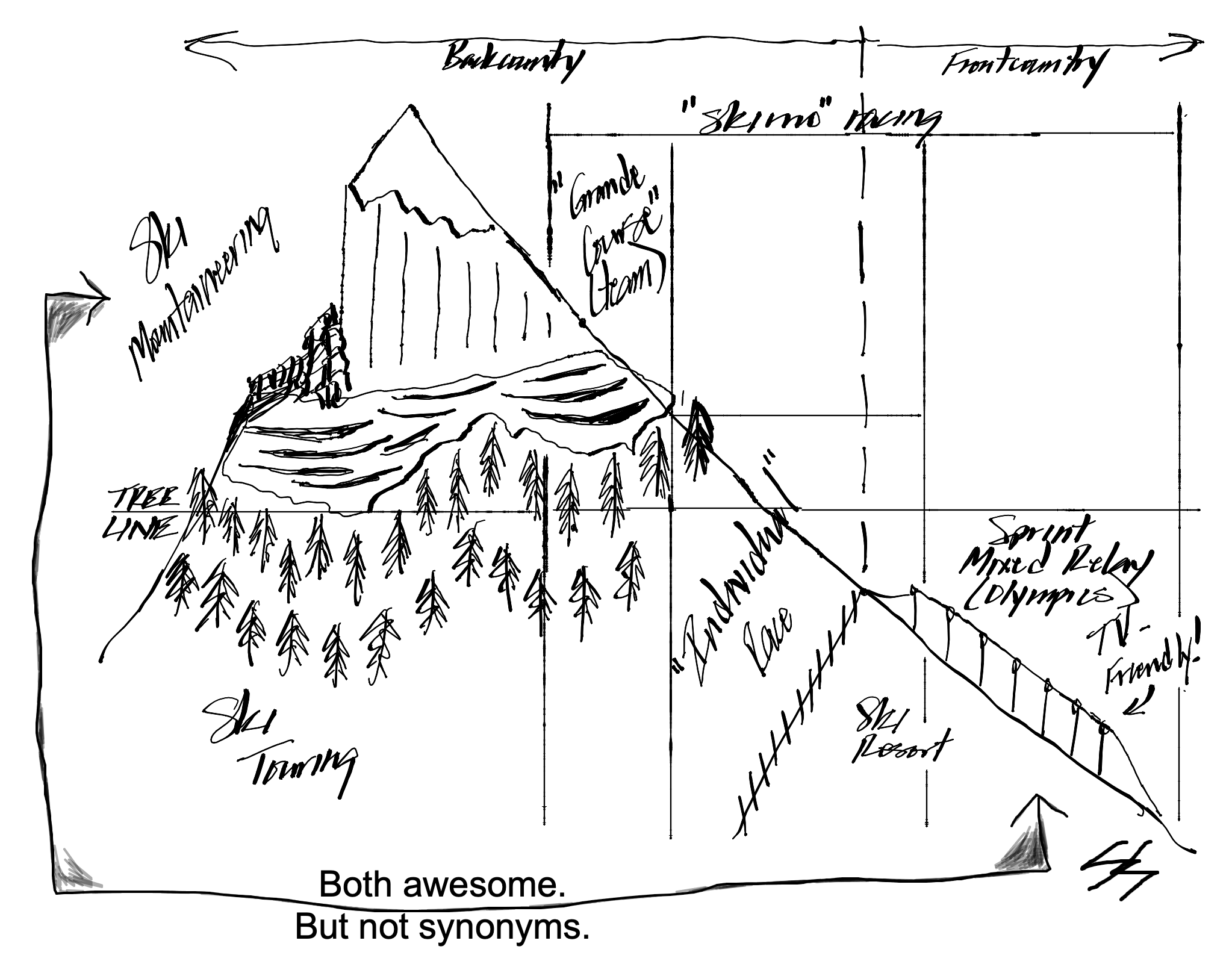
Skimo racing sits, strangely, in the middle. It's admittedly the geekiest and least similar to its roots, but it is by far the most physically demanding.2 As the name implies, most of the mountaineering has been taken out of it.3 And this "dumbing down" of the mountaineering requirements is a very, very good thing. With few to no safety concerns, pure physical performance becomes the priority. With performance as the priority, true limits can be discovered and pushed. Despite popular myths to the contrary, that can't happen in a hostile environment.4
- "But that store Salt Lake is called skimo.co!" you might think. Yes, skimo.co is a great resource for fast and light ski touring equipment. (No affiliation.) But the name comes from being one of the early importers of race gear from Europe, not ski mountaineering equipment in general (until more recently).
- I say this as an ex-alpine climber, so I'm familiar with the demands of big, dangerous objectives.
- Although grande course races are often true backcountry races—and the European versions often require true ski mountaineering skills—most of the modern competitive events are organized in and around ski resorts.
- As with sport climbing, pretend experts sometimes say, "skimo is neither". In all cases, "is neither" only reveals who can't do either.